
Health is a crown on the heads of the healthy that only the sick can see.

⚖️ Why does the world hate Israel, not Jews? 🌍
international criticism and diplomatic pressure directed at Israel, from issues of occupation and settlements to international isolation, human rights, and the BDS boycott movement
POLICY
Dr Hassan Al Warraqi
5/29/202614 min read

⚖️ Why does the world hate Israel, not Jews? 🌍
International Criticism and Diplomatic Pressure Directed at Israel
A comprehensive analysis of international criticism and diplomatic pressure directed at Israel, from issues of occupation and settlements to international isolation, human rights, and the BDS boycott movement, with a strategic reading of global political and legal transformations.
📉 International Isolation: A Strategic Reading of Political and Human Rights Transformations 🌐
A comprehensive analysis of international criticism and diplomatic pressure directed at Israel.
Since its establishment in 1948, Israel has faced widespread international criticism, which has intensified in recent years to include accusations of crimes against humanity and genocide.
This criticism focuses on human rights violations related to the "Nakba," the ongoing occupation of Palestinian territories, the expansion of illegal settlements, and the blockade of the Gaza Strip.
Recent indicators show growing international isolation, especially in Europe and "Global South" countries, with increasing calls for sanctions and arms embargoes.
In contrast, the debate over distinguishing between "criticism of policies" and "anti-Semitism" fuels an intense intellectual and legal conflict, amid accusations that the charge of anti-Semitism is used as a tool to silence political opposition.
Since its establishment in 1948, Israel has faced widespread international criticism, which has sharply escalated in recent years to include accusations of crimes against humanity and genocide.
This criticism focuses on human rights violations related to the Nakba, the ongoing occupation of Palestinian territories, the expansion of illegal settlements, and the blockade of the Gaza Strip.
Recent data shows increasing international isolation, particularly in Europe and among "Global South" countries, with growing calls for sanctions and arms embargoes.
In contrast, the debate over distinguishing between "criticism of policies" and "anti-Semitism" fuels an intense intellectual and legal conflict, amid accusations that the charge of anti-Semitism is used as a tool to silence political opposition.
1. Fundamental and Historical Axes of Criticism
a. The Nakba and the Refugee Issue
Forced Displacement: Israel's establishment is linked to the "Nakba," which saw the flight or expulsion of the majority of the Arab population in 1948.
Historians like Ilan Pappé argue that Israeli policies at the time amounted to "ethnic cleansing."
Right of Return: Israel refuses to allow Palestinian refugees to return, which, according to the international community, is a violation of international law and UN resolutions (e.g., Resolution 194).
Law of Return: This law is criticized for granting immediate citizenship to any Jew worldwide while denying displaced Palestinians the same right, described as "blatant racism."
b. Occupation and Settlement
Occupied Territories: The UN and many international organizations classify the West Bank (including East Jerusalem) and the Golan Heights as occupied territories since 1967.
Illegality of Settlements: International bodies (ICJ, EU, US) agree that building civilian settlements in occupied territories is illegal and violates the Fourth Geneva Convention.
Judaization of Jerusalem: Israeli efforts to change the demographic and physical composition of Jerusalem are seen as an attempt to impose unilateral sovereignty, described by the UN as "null and void."
2. Accusations of Crimes Against Humanity
a. Apartheid System
Human rights organizations (Human Rights Watch, B'Tselem) and Israeli figures (such as former Attorney General Michael Ben-Yair) believe Israel operates a dual legal system:
Law for Settlers: Israelis in settlements are subject to Israeli civil law.
Law for Palestinians: Palestinians in adjacent areas are subject to military orders, depriving them of basic and political rights.
Comparison to South Africa: The Association for Civil Rights in Israel describes separate road networks and discriminatory resource distribution as "a flagrant violation of the principle of equality reminiscent of the apartheid system."
b. Genocide Accusations
These accusations have escalated during recent conflicts in Gaza:
The prolonged Israeli blockade and extensive military operations are described as having cumulative destructive effects approaching genocide.
Researchers indicate that some statements and policies in Gaza reflect a destructive intent beyond military necessity.
3. Military Practices and Human Rights Violations
Targeted Killings: Amnesty International condemned the "targeted killing" policy as extrajudicial execution.
Use of "Human Shields": Cases have been documented where the Israeli army used Palestinian civilians (in what is known as the "neighbor procedure") to force wanted individuals to surrender.
Nuclear Weapons: Israel is criticized for possessing an undeclared nuclear arsenal (about 150 weapons) and refusing to sign the Non-Proliferation Treaty (NPT).
Administrative Detention and Torture: Reports indicate the detention of hundreds of Palestinians for long periods without charge, using torture methods including sleep deprivation and beatings.
4. Global Public Opinion and Increasing International Isolation
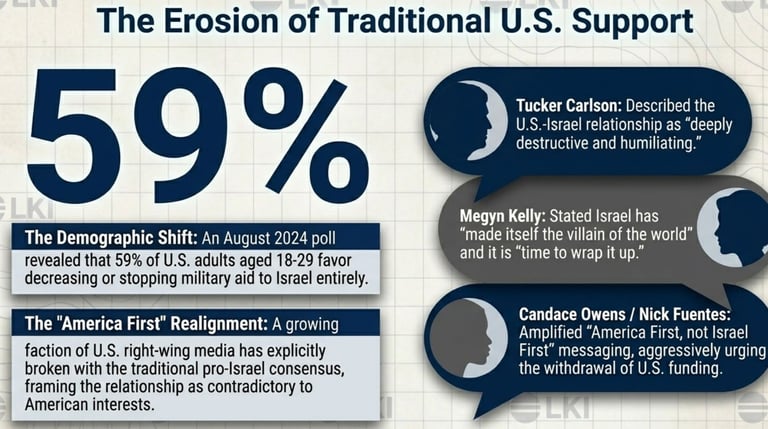
Opinion polls and diplomatic movements show a notable decline in international support for Israel.
a. Public Opinion Indicators (Approximate 2025 data)
Country
Positive Opinion
Negative Opinion
Net Index (Positive - Negative)
Turkey
4%
93%
-89
Japan
13%
79%
-66
Indonesia
17%
80%
-63
Spain
18%
75%
-57
United States
45%
53%
-8
b. European and American Isolation
Disagreements with Allies: Sharp diplomatic disputes arose with France, Spain, Italy, as well as Germany and Britain over policies in Gaza and Lebanon.
Calls for Sanctions: British and European parliamentarians called for suspending the partnership agreement with Israel and halting arms exports to it.
Shift within the US: Some American right-wing currents (e.g., Tucker Carlson, Candace Owens) have begun criticizing unlimited support for Israel, believing that an "Israel First" policy harms American interests.
5. The Debate over Criticizing Israel and Anti-Semitism
a. The Concept of "New Anti-Semitism"
Israel's supporters believe some criticism constitutes veiled attacks on Jews, using the "3D Test" to distinguish:
Demonization: Portraying Israel's actions as absolute evil.
Double Standards: Criticizing Israel for actions ignored when committed by other countries.
Delegitimization: Denying Israel's right to exist.
b. Suppressing Criticism "as a Weapon of Anti-Semitism"
In contrast, critics (including Jewish academics like Norman Finkelstein and Noam Chomsky) assert that:
The charge of anti-Semitism is used as a "bogeyman" to silence legitimate debate about human rights violations.
This excessive use leads to the "dilution" of genuine anti-Semitism and may backfire.
Targeting Journalism: About 200 journalists have been killed in Gaza, described as a "media blackout" to prevent uncovering facts.
6. Reactions and Counter-Movements
a. The Boycott, Divestment, Sanctions (BDS) Movement
Launched in 2005 as a global peaceful movement aiming to:
End occupation and dismantle the wall.
Recognize the full rights of Palestinians within Israel.
Implement the right of return for refugees.
Israel considers this movement a "strategic threat" and has enacted laws criminalizing participation in boycotting settlements.
b. Official Israeli Position
The Israeli Foreign Ministry claims there is media and international bias (especially at the UN) against it.
The majority of Israelis (75% according to a 2010 poll) feel that "the whole world is against us" regardless of their actions.
Israel asserts that UN criticism is disproportionate and ignores more bloody conflicts, calling it "double standards."
The Debate over Criticizing Israel and Anti-Semitism (repeated)
The link between criticizing Israeli policies and anti-Semitism is one of the most controversial issues:
The Concept of "New Anti-Semitism"
Israel's supporters argue that some criticism is a veiled attack on Jews, using the "3D Test":
Demonization
Double Standards
Delegitimization
Suppressing Criticism as a "Weapon of Anti-Semitism"
Critics (including Jewish academics like Norman Finkelstein and Noam Chomsky) assert that the charge of anti-Semitism is used as a "bogeyman" or "weapon" to silence legitimate public debate about human rights violations.
This excessive use leads to the dilution of genuine anti-Semitism and may backfire.
Targeting Journalism
Nearly 200 journalists have been killed in Gaza, described as a "media blackout" to prevent uncovering facts.
7. Key Quotes
"Israel cannot be defined as a democracy when a Jewish minority rules over a Palestinian majority between the Jordan River and the Mediterranean Sea, controlling millions of people without political rights." — Avraham Burg (former Speaker of the Israeli Knesset)
"Criticism of Israel is immediately suppressed in the US by labeling it anti-Semitism, as if Palestinians are not Semites." — Archbishop Desmond Tutu
"Apartheid was a system that criminalized normal behavior and normalized criminal behavior... We see similarities in the systematic oppression of Palestinians." — Sandile Edwin Shalk (former South African High Commissioner to Sri Lanka)
8. Summary of International Human Rights Reports
a. Classification of the "Apartheid" System
Amnesty International and Human Rights Watch: Both organizations confirmed in detailed reports that Israel imposes a systematic regime of repression and domination over Palestinians, aimed at maintaining a Jewish majority and control over land and resources.
Harvard Law School Human Rights Clinic: Provided a legal analysis to the UN that Israeli practices in the West Bank violate the prohibition of apartheid.
Spatial Fragmentation: Reports document how the Palestinian people are fragmented geographically and legally to undermine their rights.
b. Genocide and War Crimes Accusations in Gaza
UN (OHCHR): A 2026 briefing report noted "serious concerns" regarding Israel's compliance with ICJ orders and its obligations to prevent genocide.
Amnesty International (2024 report): Concluded there is sufficient evidence to believe that Israel's conduct in Gaza since October 7, 2023, amounts to genocide.
Starvation as a Weapon: UN and Human Rights Watch reports documented the use of starvation as a method of warfare through a comprehensive blockade and obstruction of aid, leading to famine in areas of Gaza.
c. Targeting Civil Society and Journalism
Criminalizing Six Organizations: The EU and the UN High Commissioner for Human Rights criticized Israel's designation of six Palestinian human rights organizations as "terrorist" organizations without evidence.
Killing of Journalists: The UN Human Rights Office documented the killing of 243 journalists and media workers in Gaza as of May 2025, with concerns of intentional targeting.
d. Arbitrary Detention and Torture
Systematic Torture: Former detainees reported severe beatings, waterboarding, hanging from ceilings, and sexual violence.
Administrative Detention: Israel expanded its use, with the number of administrative detainees reaching 3,562 by May 2025.
Holding Corpses: Israel holds 476 bodies (as of October 2025) as "bargaining chips," which human rights groups view as collective punishment.
e. Settler Violence and Forced Eviction
Organizations (Yesh Din, B'Tselem) document the failure of Israeli authorities to investigate 91% of settler violence complaints, encouraging attacks aimed at displacing Palestinians.
Reports describe planning and demarcation policies in Jerusalem and the Negev as discriminatory, aiming to "Judaize" the land through house demolitions under the pretext of unlicensed construction.
9. Legal Basis for Classifying Israel as an "Apartheid" System
Reports rely on definitions from the 1973 Apartheid Convention and the Rome Statute, which require three pillars:
Inhumane acts in the context of an institutionalized regime of oppression.
Systematic domination by one racial group over another.
Intent to maintain that regime.
Documented Evidence:
Dual Legal System: Palestinians under military law (99% conviction rate), settlers under civil law.
Inhumane Acts: Administrative detention, torture, movement restrictions (checkpoints, permits, separation wall), unlawful killing.
Discriminatory Land and Housing Policies: "Absentees' Property" laws, discriminatory planning preventing building permits for Palestinians.
Intent of Domination: The "Nation-State Law" (2018) stating that the right to self-determination is "unique to the Jewish people" and making settlement a "national value," along with demographic policies (Law of Return, family reunification restrictions).
10. Criticisms of the Israeli Nation-State Law (2018)
Entrenching Discrimination and Apartheid: Constitutionally grants exclusive privileges to Jews at the expense of others.
Monopolizing Self-Determination: Absolutely denies the right of Palestinians to self-determination.
Making Settlement a "National Value": Legalizes settlement expansion without geographical boundaries.
Erasing Palestinian Identity: Defines Palestinians as an "ethnic minority" rather than a people with national rights.
Omitting the Principle of Equality: Lacks any mention of equality, removing constitutional protection for Palestinians inside Israel.
International Comparisons: Described as reviving the "spirit of Hitler" and indicating Israel's shift towards authoritarianism.
11. The Role of the BDS Movement in Pressuring Israel
Israel considers the BDS movement one of the greatest "strategic threats" due to its success in isolating Israel academically, culturally, politically, and economically.
The Three Pillars of Pressure:
Boycott: Boycotting Israeli companies, institutions, sports, cultural, and academic events.
Divestment: Pressuring banks, universities, and pension funds to divest from companies involved in the occupation.
Sanctions: Pushing governments to halt military cooperation, end trade agreements, or expel Israel from international forums.
Impact:
Academically and Culturally: Student protests swept global universities; ethics committees at European universities (e.g., Ghent) recommended ending research cooperation with Israel; calls increased to expel Israel from FIFA and UEFA.
International Isolation: Contributed to raising public awareness, especially in Europe and the US, providing moral cover for accountability demands.
Israeli Reaction (Evidence of Effectiveness): The Knesset passed a law criminalizing boycotting settlements (2011), took measures to prevent BDS supporters from entering, and used propaganda machinery to brand the movement as "anti-Semitic."
FAQs: ⚖️ Why does the world hate Israel, not Jews? 🌍
1. What is the legal basis for classifying Israel's practices as "apartheid"?
The 1973 Apartheid Convention and the Rome Statute, based on the existence of a dual legal system, inhumane acts, and the intent to perpetuate Jewish domination.
2. Why does Israel face genocide accusations at the International Court of Justice?
Due to a case filed by South Africa based on mass killing, causing serious bodily and mental harm, and imposing living conditions intended to bring about the physical destruction of Palestinians in Gaza.
3. What are the most prominent criticisms of the 2018 Nation-State Law?
Reserving the right to self-determination for Jews only, ignoring the principle of equality, and legitimizing settlements as a "national value."
4. How does the BDS movement pressure Israel?
Through academic, economic, and cultural boycotts, divestment, and government sanctions.
5. What are the most prominent UN-documented violations in Gaza?
Record levels of casualties (mostly women and children), using starvation as a weapon of war, and documented systematic torture of detainees.
6. What is required of the international community according to reports?
Stop selling and transferring weapons to Israel, review cooperation agreements, and hold officials accountable before the International Criminal Court.
Kosher Food FAQs
What is Kosher food?
Kosher food is food permitted for consumption according to Jewish law, subject to specific rules regarding ingredients, preparation, and animal slaughter.
What does "Kosher" mean?
The word "Kosher" or "Kashér" means "fit" or "proper" in Hebrew, meaning the food complies with Jewish dietary laws.
What foods are permitted in the Kosher system?
The Kosher system includes:
Meat slaughtered according to Jewish law
Fish with fins and scales
Fruits and vegetables
Certified Kosher dairy products
Permitted grains and legumes
What foods are prohibited?
Pork
Shellfish and crustaceans
Animals not slaughtered according to religious law
Mixing meat with dairy products
Why are meat and dairy not mixed in Kosher food?
It is based on a Jewish religious interpretation of Torah verses that forbid "cooking a kid in its mother's milk," hence the separation of meat and dairy products in preparation, serving, and even kitchen utensils.
Is Kosher food healthy?
Kosher food can be healthy because it undergoes strict control and standards, but its healthiness also depends on ingredient quality and cooking methods.
What is the difference between Kosher food and Halal food?
There are similarities between Kosher and Halal, such as:
Prohibition of pork
Specific slaughter conditions
However, there are differences, such as:Prohibition of mixing meat and dairy in Kosher
Some seafood permitted in Halal is not permitted in Kosher
How can I tell if a product is Kosher?
Products usually bear a Kosher certification symbol from a specialized supervisory body, such as: OU, OK, KOF-K, Star-K.
Can vegetarians eat Kosher food?
Yes, most plant-based foods are Kosher if they do not contain prohibited ingredients or become contaminated during preparation.
Can sweets be Kosher?
Yes, there are Kosher sweets made with certified ingredients and without mixing contrary to Jewish dietary laws.
Do Kosher restaurants exist outside Israel?
Yes, Kosher restaurants and markets exist in many countries such as the US, France, Britain, and Canada, especially in areas with significant Jewish communities.
Does Kosher food require certification?
Yes,
products and restaurants usually require Kosher certification from an accredited body to ensure compliance with Jewish dietary laws.
What are the benefits of choosing Kosher food?
Strict control standards
High-quality ingredients
Attention to cleanliness and food safety
Suitable for certain dietary and religious systems
Can Muslims eat Kosher food?
Some Muslims may eat Kosher food under certain circumstances, but juristic opinions differ depending on the type of food, slaughter method, and ingredients used.
Kosher Food
Kosher food is a religious dietary system in Judaism that specifies permitted foods and their preparation method according to Jewish law (Halakha).
✡️ Most Important Rules of Kosher Food
🥩 Permitted Animals
They must be ruminants with cloven hooves, such as:
Cattle
Sheep
Goats
🚫 Therefore prohibited:
Pork
Rabbit
Some other animals
🐟 Permitted Fish
They must possess:
Fins
Scales
✅ Examples: Salmon and tuna
🚫 Prohibited: Shrimp, crab, shellfish
🩸 Prohibition of Blood
Animals must be slaughtered in a special religious way, and the blood must be completely drained.
🥛🍖 No Mixing Meat and Dairy
One of the most famous Kosher rules:
Do not cook or eat meat with milk or its derivatives
Sometimes, separate utensils are used for each type
🕍 The Purpose of Kosher
Jews see it as part of:
Religious purity
Spiritual discipline
Commitment to Jewish law
Many products around the world bear the Kosher symbol to indicate compliance with these rules.
Additional Details about Kosher Laws
Three Food Classifications: Kosher foods are divided into three main categories:
Meat (Bari): Includes permitted animals and birds slaughtered according to law.
Dairy (Halavi): Includes milk and its derivatives from Kosher animals.
Pareve (Neutral): Foods that are neither meat nor dairy, such as: fish, eggs, fruits, vegetables, grains, and nuts. Pareve can be eaten with either of the other groups (except that fish is not mixed with meat in the same dish according to some Talmudic opinions).
Separating Utensils and Tools: Observant Jews not only separate utensils for meat and dairy but also separate cooking utensils (pots, pans, knives, cutting boards) and tableware (plates, cups, spoons).
In observant homes, there are usually two complete sets of utensils in different colors to distinguish them.
Each set must be washed in a separate sink or in the same sink using a special Kosher strainer to ensure no residue mixes.
Slaughter Method (Shechitah): The animal is slaughtered by cutting the jugular vein quickly with a very sharp, flawless knife.
This method aims for a quick and painless death according to law. The person performing the slaughter is called a "Shochet" and must be trained and religiously certified.
Salting Meat (Removing Blood): After slaughter, meat is soaked in water for half an hour, then salted with coarse salt for a full hour (the salt absorbs the blood), then rinsed thoroughly to remove salt and blood.
This is why Kosher meat is often slightly salty if not soaked well.
Commercial Kosher Symbols: It is not enough that ingredients are Kosher; the entire production process must be under rabbinic supervision.
There are hundreds of commercial symbols (Hechsherim) worldwide. The most famous include:
OK (Organized Kashrut)
OU (Orthodox Union)
Kof-K
Star-K
In the Arab world, you might sometimes find the CRC (Conference of European Rabbis) symbol on imported products.
Dairy Products (Chalav Yisrael): Some strict interpretations require milk to be pasteurized or supervised under Jewish supervision throughout the process (from milking to packaging) to ensure it is free from milk of non-Kosher animals.
This product is called "Chalav Yisrael."
Bread (Pat Yisrael): Even bread, even with simple ingredients (flour, water, salt), preferably comes from a Jewish bakery or a Jew participates in its baking process to be considered fully Kosher (Pat Yisrael), especially concerning holy bread used in religious occasions.
Historical and Cultural Overview:
Middle Ages: Jewish scholars (like Maimonides) found wisdom in Kosher laws, such as the prohibition of blood because it was associated with ancient pagan rituals and considered the vessel of life, and the prohibition of mixing meat and milk perhaps to prevent imitating the customs of neighboring pagan nations (according to some interpretations).
Present: Kosher food has become a global market worth millions of dollars, not only for Jews but also for Muslims (because some of its rules resemble Halal, with some differences like alcohol) and for vegetarians and vegans (because its laws prevent mixing meat and dairy, making product classification easier), and for consumers concerned with cleanliness and quality.
Conclusion: Kosher is not just a food list; it is an integrated lifestyle touching every aspect of food from slaughter to eating, representing a deep-rooted religious and cultural identity.
Would you like to delve deeper into a specific point, such as the difference between Kosher and Halal, or Jewish holiday food laws?
====================================================================================================================================================================================
⚖️ Why does the world hate Israel, not Jews? 🌍
For many people, criticism is directed at the actions and policies of the Israeli state, not at Jewish people or Judaism. A government's decisions can be opposed without hating an entire religion or ethnic group.
🕊️ Criticizing a state is not the same as hating a people.
https://www.h-k-e-m.com/-why-does-the-world-hate-israel-not-jews-
International Criticism and Diplomatic Pressure Directed at Israel
Keywords: International criticism of Israel, diplomatic pressure, international isolation, human rights, Israeli occupation, settlements, Gaza, Palestinian cause, international law, war crimes, apartheid, United Nations, BDS movement, Palestinian-Israeli conflict
Hashtags: #Israel #Palestine #Gaza #Occupation #Settlements #HumanRights #InternationalLaw #InternationalIsolation #DiplomaticPressure #PalestinianCause #WarCrimes #Apartheid #UN #BDS
⚖️ Why does the world hate Israel, not Jews? 🌍
International Criticism and Diplomatic Pressure Directed at Israel
Israel faces escalating international criticism, focusing on:
Occupation and Settlements: Expanding settlements in occupied Palestinian territories (West Bank and East Jerusalem) is a violation of international law.
Apartheid System: Human rights organizations (Amnesty International, Human Rights Watch) describe Israeli policies as systematic oppression of Palestinians, with a dual legal system (civil for settlers, military for Palestinians).
Genocide Accusations in Gaza: Comprehensive blockade, starvation, killing tens of thousands of civilians (mostly women and children), according to UN and judicial reports (ICJ).
Human Rights Violations: Administrative detention without trial, torture, house demolitions, settler violence.
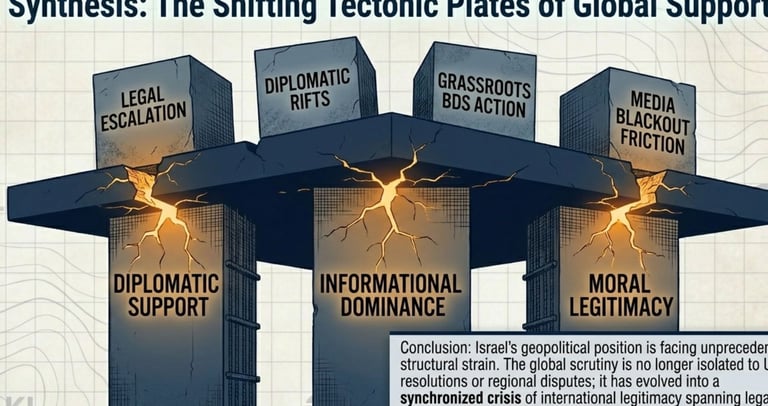
International Isolation: Declining popular support globally (especially in Europe and the Global South), and calls for sanctions and arms embargoes.
Debate over Anti-Semitism: Israel accuses its critics of anti-Semitism, while others argue the accusation is used to silence legitimate criticism of policies.
The BDS movement exerts economic and academic pressure, and Israel considers it a strategic threat.
Conclusion: The criticism does not mean "hatred of Israel" but rather rejection of specific policies related to occupation and human rights.
====================================================================================================================================================================================
Fasting in Gulf War Syndrome: An Aid to Healing? 🧠🕊️
Evidence suggests that intermittent fasting may be a promising aid for healing from Gulf War Syndrome, for the following reasons:
It stimulates autophagy, which helps repair damaged mitochondria (the core dysfunction in the syndrome).
It reduces chronic inflammation in the body and brain.
Its success is supported by the success of the "low-glutamate diet," which has shown significant improvement in symptoms.
⚠️ Note: This is still a preliminary research area, and it is essential to consult a doctor before starting. It is preferable to try mild fasting patterns like 16:8 gradually.

Get in touch
Address
Cairo Al Rehab
Contacts
+20 109 405 2056
hassanalwarraqi@h-k-e-m.com