Health is a crown on the heads of the healthy that only the sick can see.


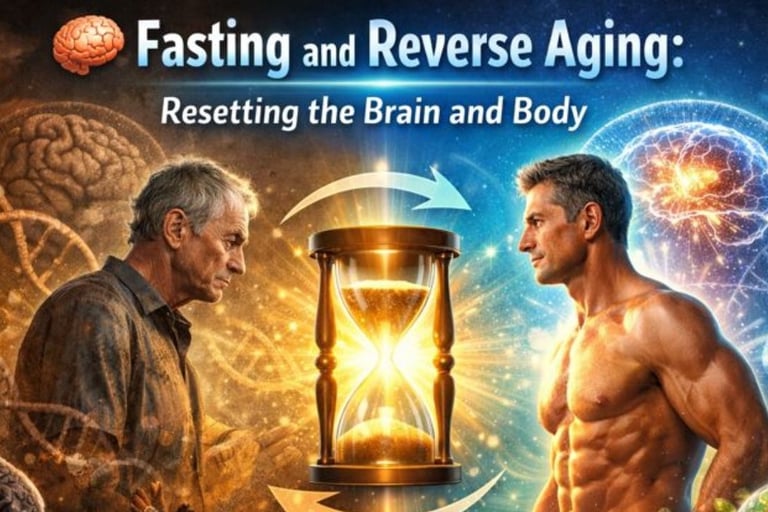
🧠 Fasting and Reverse Aging : Resetting the Brain and Body
Scientific insights into fasting and reverse aging, including cellular repair, epigenetic changes, and mitochondrial health.
FASTINGISLAMICGENERAL
Dr Hassan Al Warraqi
2/17/202615 min read

🧠 Fasting and Reverse Aging : Resetting the Brain and Body
Scientific insights into fasting and reverse aging, including cellular repair, epigenetic changes, and mitochondrial health.
Aging was once seen as irreversible. Today, science suggests otherwise.
Emerging research shows that fasting can activate cellular repair, reprogram gene expression, and slow—or partially reverse—biological aging.
Fasting doesn’t stop time, but it may reset the body’s aging clock.
like fasting and cutting calories seem to be pretty powerful tools, showing signs of slowing down aging in studies with everything from yeast to monkeys.
Instead of just living longer, the real goal is to keep our cells acting young, stay strong and sharp, dodge age-related diseases, and stretch out the time we're actually healthy.
It's no longer about if we can mess with aging, but how much we can push it and stay kicking for longer.
The Hayflick Limit: How One Idea Upended Aging Science
Back in the '60s and '70s, a biologist named Leonard Hayflick did some experiments that flipped everything we thought we knew about aging on its head.
He was playing around with human cells in the lab and noticed something weird: cells can't just keep dividing forever.
Before him, people figured if cells had enough food, they could basically live forever, or at least keep splitting forever.
Hayflick proved that wasn't true.
Normal human cells have a limit built in, around 40 to 60 splits, then they stop.
That became the Hayflick limit, and it was the first solid proof that aging is kind of programmed into our cells.
When Cells Retire: Understanding Senescence
Once cells hit that Hayflick limit, they go into a weird state called senescence.
These old cells don't split or make more copies, but they still stick around and cause problems.
Think of them like workers who retire but still show up to the office every day, not doing their jobs and messing with everyone else.
These zombie cells build up as we get older and cause all sorts of issues:
* Tissues Fall Apart: Old cells stop doing what they're supposed to, so tissues get weak, organs don't work as well, and it's harder to heal.
* Constant Grumbling: These cells put out inflammatory stuff that bugs healthy cells nearby, leading to problems like heart disease and arthritis.
* Harder to Heal: Zombie cells block healthy stem cells and mess up how our bodies fix themselves.
* More Diseases: The inflammatory environment that these cells create is linked to nasty stuff like heart problems, Alzheimer's, arthritis, diabetes, and even cancer.
Hayflick's discovery was huge because it showed that aging isn't just random wear and tear, but something with specific steps we can try to target.
The Hallmarks of Aging : Why Do Our Cells Get Worse?
Over the years, researchers have looked at Hayflick's work and identified the interconnected biological happenings, that are the root cause of cells losing function over time, and they affect pretty much everything in our bodies.
There are nine of these hallmarks that have been laid out in papers from 2013, and updated in 2023,.
We'll focus on the ones that seem important and the ones that we can change with things like fasting and how we live.
1. DNA Damage Pileup
Every day, your DNA gets dinged up.
This adds up over time because of:
* Outside Stuff:
* Sun
* Pollution
* Chemicals from pesticides, plastics, and processed foods
* Medical X-rays
* Inside Problems:
* Errors when cells copy DNA
* Stress from normal cell stuff
* Chemical reactions that mess with DNA
When we're young, our cells can fix most of this, but as we age, those repair systems get lazy.
So, we end up with mutations that screw up cell work, mess with how cells talk to each other, and seriously up the risk of cancer, brain diseases like Alzheimer's and Parkinson's, and problems like diabetes.
Think of DNA damage like little cracks in a house's foundation.
A few aren't a big deal, but tons of them can make the whole thing fall apart.
2. Telomere Trouble
Telomeres are like caps on the ends of your DNA, preventing them from fraying.
How They Work as an Aging Clock:
Every time a cell divides, it can't copy the very ends of those caps. So, telomeres get shorter each time.
This acts like a timer, counting down how many splits a cell has left.
When telomeres get too short, cells have to make a choice:
* Retire: The cell stops splitting but sticks around, causing the problems that were mentioned before.
* Self-Destruct: The cell kills itself, which is sometimes better than just hanging around.
This then causes tissues to slow down at healing.
Telomeres and Disease:
Research shows that short telomeres are linked to:
* Shorter life
* More heart problems
* Higher cancer rates
* Brain decline
* Weak immune system
* Inflammation
Telomere length isn't just about age.
Things like stress, bad diet, not moving enough, and smoking can shorten them faster.
But things like being active, chilling out, and eating well can help slow down or even fix telomere loss a little.
3. Mitochondria Slowdown
Mitochondria are the power plants of our cells.
They make the energy that runs everything in your body.
Why Mitochondria Get Lazy With Age:
* Less Output: The process that makes energy gets sluggish, so you get less juice from the same amount of fuel.
* More Pollution: Damaged mitochondria make these harmful molecules that hurt DNA, proteins, and fats.
* Quality Control Fails: Cells have ways to get rid of bad mitochondria, but those systems weaken as we age, so the bad ones build up.
* Fewer New Ones: Making new, healthy mitochondria slows down, so the old ones don't get replaced.
How This Messes Up Your Body:
When cell energy drops, it messes with everything:
* Tiredness
* Brain fog
* Weak muscles
* Weak immune system
* Faster aging
* Inflammation
Organs that need a lot of energy, especially the brain, heart, and muscles, are hurt the most by this, which is why they often show the biggest signs of aging.
Epigenetics : A Way to Rewind Aging ?
One of the biggest breakthroughs in understanding aging is epigenetics.
This is the study of how genes get turned on or off without changing the DNA itself.
Think of your DNA as a huge library with all the instructions for building and running your body.
Epigenetics decides which books get pulled off the shelves and read at any time.
The books are the same, but which ones are being used changes constantly.
How Epigenetics Works
* DNA Marking: It's like putting notes saying don't read on books in the library.
* Histone Tweaks: DNA wraps around proteins called histones. Changing these proteins decides how tightly DNA is packed, and which genes are easy to read.
* Remodeling: The structure of DNA can be changed to make some genes easier or harder to get to.
All of this is super important when we're developing in the womb, deciding which cells become brain cells, heart cells, whatever.
But it also keeps happening throughout life, responding to what we eat, how stressed we are, and how we live.
The Epigenetic Clock
As we age, patterns of epigenetic changes build up.
Researchers have pinpointed changes that happen pretty consistently in everyone.
These changes have been used to make epigenetic clocks – tools that can guess your age based on these markers.
Rewinding the Clock?
Genetic mutations are permanent.
Epigenetic changes might be reversible.
Since epigenetic changes don't alter the DNA, they could theoretically be reset.
The books in the library are still there–we just need to reorganize them.
This is what led scientists to wonder: If we can reverse epigenetic aging, can we reverse aging itself?
Based on early research, the answer seems to be yes.
Studies have shown that we can reverse epigenetic age using different methods.
Things You Can Do : Practical Ways to Influence Aging
Caloric restriction and Fasting: These are some of the most studied ways to go about aging.
Research shows that it can: Reduce DNA Damage, Improve Insulin Sensitivity, Activate Cellular Repair, Enhance Mitochondrial Efficiency, Reduce Oxidative Stress, Lower Inflammation
Fasting has its effects by activatating sirtuins, which in turn control metabolic balance, DNA repair, inflammation control, mitochondrial function, and stress resistance.
Types of Fasting and Their Benefits
* Intermittent Fasting (IF): Rotating between eating and fasting daily.
* Time-Restricted Eating (TRE): Eating within a smaller window, typically 6-10 hours.
* Alternate Day Fasting (ADF): Switching between normal and very low-calorie days.
* Prolonged Fasting: Longer fasting periods, like monthly or quarterly.
* Fasting-Mimicking Diet (FMD): A diet designed to trick the body into thinking it's fasting.
Each approach can some benefits.
Anti-Aging Compounds and Metabolic Support
Alongside lifestyle changes, there are some compounds that show potential for restoring cellular function:
* NMN (Nicotinamide Mononucleotide): shown success in enhancing mitochondrial function, improving insulin sensitivity and metabolic health, supporting cardiovascular function, enhancing cognitive performance
* Remodelin: May improve nuclear envelope stability, Enhance epigenetic regulation,Support proper gene expression patterns
* Resveratrol
* Metformin
* Spermidine
* Rapamycin
Exercise : a great anti-aging tool
If there were a pill that was as effective as exercise, it would be labeled a miracle.
Activity remains one of the best anti-aging options, with benefits that extend across the body.
*Aerobic Training: cardio. Activities improve cardiovascular health, mitochondrial function, and metabolic efficiency.
*Resistance Training: Strength training preserves muscle mass, improves metabolic rate, and enables independence.
*High-Intensity Interval Training (HIIT): stimulate mitochondrial biogenesis and improving cardiovascular fitness.
Stress Reduction, Meditation, and Cellular Longevity
Stress is a big deal when it comes to aging.
But meditation, breathwork has some benefits.
Meditation practices is associated with longer telomeres.
Sleep: A Critical Requirement
* Clearance of metabolic waste
* DNA repair
* Hormonal regulation
* Immune system strengthening
* Memory
Moving Forward
Things that seemed impossible 10 years ago and now being conducted in labs.
While we can't completely eliminate or reverse aging, we can affect it and sustain functions far longer than we assumed.
Frequently Asked Questions: Fasting and Aging in Reverse
General Questions About Aging and Reversing It
Can we turn back time on aging?
You can't totally reverse aging,
but new studies show you can undo some of the stuff that ages you at the cell level.
Things like changes to your genes, telomere length, how well your mitochondria work, and inflammation can all get better if you do the right things.
Think of it as making your body younger, even if you can't be 20 again. Studies looking at genes have seen people get 1-3 years younger just by changing how they live, and some new treatments are doing even better.
What's the deal with biological age vs. regular age?
Regular age is just how old you are based on your birthday.
Biological age is how old your cells and body are, based on things like your genes, telomere length, and how healthy you are.
Two 50-year-olds might have a biological age of 40 and 60, it depends on their genes, life, and health.
The point of trying to slow aging is to keep your biological age lower than your actual age.
How much of aging comes from our genes, and how much can we control?
It seems like genes are only about 20-30% of why we age, while what we do and where we live counts for about 70-80%.
That's good news because it means we have a lot of control. Studies on identical twins show they can age very differently if they make different choices, even though they have the same DNA.
When should I think about trying to slow aging?
Now is the best time, no matter how old you are.
It's always easier to stop something before it happens.
But, it's never too late to start.
Studies show even people in their 60s, 70s, and 80s can get healthier by changing how they live.
The things that fix our cells when we fast or exercise still work even when we're older, they just might be a bit slower.
Is reversing aging real, or is it just a fad?
It's real science, but it's often blown out of proportion.
Studies show we can for sure improve or undo some things that age us, that's proven.
But, saying we can totally reverse aging or live forever isn't true right now.
What's true is we can slow aging a lot and undo some of the cell and gene damage that happens as we get older.
Questions About Fasting
What kind of fasting is best for anti-aging?
Different types of fasting give you different benefits, so the best one depends on you, your health, and what you want:
* Intermittent Fasting (16:8): Easy to do every day; good for your body and cleaning up cells.
* Time-Restricted Eating: Like intermittent fasting, but you eat during the same hours each day.
* Alternate Day Fasting: More intense, may help clean up cells better.
* Longer Fasts (24-72+ hours): Really good for cleaning cells and making new stem cells, but do it every once in a while, not all the time.
* Fasting-Mimicking Diet: Like fasting, but you eat a few calories; good if you can't do full fasting.
Most studies say it's better to be consistent than to do the perfect type of fasting.
Starting with 16:8 intermittent fasting is usually easiest for beginners.
How long do I have to fast to see benefits?
You'll see benefits at different times:
* 12-16 hours: Starts cleaning up cells; your body starts burning fat.
* 16-24 hours: Really cleans up cells.
* 24-48 hours: Cleans cells even more; growth hormone goes up; cells get stronger.
* 48-72 hours: Starts making new stem cells; your immune system gets a boost; fixes cells a lot.
But even fasting for 12-16 hours a day can help a lot if you do it for months or years.
You don't have to do long fasts to get better, but doing them sometimes (safely) can give you extra benefits.
Is fasting safe for everyone?
No way. Fasting isn't good for:
* Women who are pregnant or breastfeeding
* Kids (they're still growing)
* People who have had eating problems
* People with some health issues (like diabetes that's not controlled, low blood pressure, etc.)
* People on some medicines
* People who are underweight
Always talk to a doctor before you start fasting, especially if you're not healthy or take medicines.
Will fasting slow down my body's engine?
People worry about this, but it's not really true.
Fasting for a short time (up to 48-72 hours) actually makes your body's engine run faster by 3-14% because of adrenaline. This helped our ancestors stay awake when they were looking for food.
Your body's engine slows down if you eat too few calories every day for a long time, not if you fast sometimes.
The thing is, intermittent fasting keeps your hormones balanced so your engine doesn't slow down.
What can I have while fasting without messing it up?
To keep the healthy aging benefits, you can have:
* Definitely OK:
* Water
* Black coffee (no sugar or cream)
* Plain tea (no sugar)
* Salt (really important for longer fasts)
* Maybe OK:
* Coffee with a tiny bit of MCT oil or butter
* Apple cider vinegar (a little bit)
* Lemon juice in water (a little bit)
* Will break the fast:
* Any food
* Protein shakes
* Cream or milk in coffee
* Sweeteners
* Bone broth
The stricter you are, the better the benefits.
Can I work out while I'm fasting?
Yes, you can, and it might even make it better. Working out while fasting:
* Burns more fat
* Helps clean up cells better
* Makes your mitochondria work better
* Makes more growth hormone
But:
* Start easy when you're starting to work out while fasting
* Hard workouts might be harder
* Drink lots of water
* Listen to your body, stop if you feel bad
* Athletes might need to plan their fasting carefully
A lot of people like working out in the morning while they're doing intermittent fasting.
Will I lose muscle if I fast?
Fasting for a short time (16-24 hours) won't make you lose muscle.
Fasting actually makes more growth hormone, which helps keep your muscle. Your body burns fat, not muscle, if you:
* Eat enough protein when you're not fasting
* Keep lifting weights
* Don't fast for too long all the time
* Eat enough calories (fasting is about when you eat, not eating less)
You'll lose muscle if you eat too few calories or fast for days without eating right.
Questions About Specific Aging-Fighting Stuff
What are telomeres, and why do they matter?
Telomeres are like the plastic tips on shoelaces at the end of your DNA.
Every time a cell splits, the telomeres get a little shorter.
When they get too short, the cells can't split anymore and either die or become zombie cells.
Telomere length tells you how old your cells are.
Shorter telomeres mean you're more likely to get old-age diseases and not live as long.
But, you can change your telomere length.
Exercise, less stress, and a healthy diet can all slow down telomere shortening or even make them longer.
What's autophagy, and why is it so important?
Autophagy is like your cells' cleaning and recycling system.
Cells break down and get rid of damaged proteins and stuff. Think of it as taking out the trash and recycling it.
Autophagy is super important for:
* Getting rid of bad mitochondria
* Clearing out toxic proteins (stops brain problems)
* Recycling cell parts for energy when you're fasting
* Removing busted cell parts that age you
* Helping your immune system
Autophagy slows down as you age, which makes your cells not work as well.
Fasting is one of the best ways to make autophagy work better.
What are senescent cells?
Senescent cells are cells that have stopped splitting, but they don't die.
They build up as you age and cause problems by:
* Making inflammation
* Messing up how your body works
* Causing old-age diseases
* Getting in the way of stem cells
* Making low-level inflammation
They're called zombie cells because they're not alive, but not dead either.
New drugs called senolytics are trying to kill these cells, and they seem to help in animal studies.
How does bad mitochondria mess with aging?
Mitochondria make energy for your cells. As we age:
* Mitochondria don't work as well
* They make more bad stuff called ROS
* Busted mitochondria build up
* We don't make new mitochondria as much
This causes:
* Less energy
* More cell damage
* Organs don't work so well (especially in the brain and muscles)
* Aging happens faster
Things that make mitochondria work better, like fasting, exercise, and boosting NAD+, can undo some of this.
What are epigenetic clocks?
Epigenetic clocks measure your biological age by looking at patterns on your DNA.
They can guess your biological age pretty well, usually within 2-3 years.
The most known clocks are:
* Horvath clock
* Hannum clock
* PhenoAge
* GrimAge
* DunedinPACE
These tests let scientists and people see if they're really slowing or reversing aging, not just feeling better.
Questions About Supplements
What is NMN, and does it work?
NMN is a helper molecule that makes NAD+, which goes down as you age.
NAD+ helps with:
* Making sirtuins work (good for living longer)
* How well your mitochondria work
* Fixing DNA
* Energy
Studies show:
* Animals get way better: better body function, more energy, better brain.
* Human studies are starting, and looking good.
* A lot of people say they have more energy, but it's different for everyone.
There's enough proof that a lot of scientists who study aging take NMN,
but we don't know the long-term effects on people yet.
Should I take resveratrol?
Resveratrol is in red wine, and people thought it might be why the French stay healthy. It helps sirtuins and is an antioxidant.
But:
* Works well in cells and animals
* Doesn't work as well in people, it's hard for the body to use
* Not enough in red wine to help
* Supplements aren't always good quality
* Might help when you do other things too
Maybe helpful as part of a plan, but not a magic fix.
What about metformin for anti-aging?
Metformin is a diabetes drug that might help with aging.
What we know:
* Helps AMPK, which is a body sensor
* Makes your body more sensitive to insulin
* Might lower inflammation
* Being tested for aging effects on people
Consider:
* Need a prescription
* Can mess with B12
* Might make exercise not work as well
* We don't know the long-term safety for everyone
Scientists are hopeful, but not for sure.
Are there supplements everyone should take?
No, but some are recommended.
* Vitamin D (if you don't have enough)
* Omega-3 fatty acids
* Magnesium (most people don't get enough)
* NMN or NR
* CoQ10
* Vitamin K2
Eat well first, then supplements.
Get your blood tested to see what you need.
Questions About Exercise and Lifestyle
What kind of exercise is best?
The best is a mix of things:
* Exercise that makes you breathe hard (150-300 min/week)
* Good for your heart
* Makes your mitochondria work better
* Lifting weights (2-3 times/week)
* Keeps your muscle
* Helps your body work
* Hard workouts (1-2 times/week)
* Good for your cells
* Easy exercise
* Builds a body base
* Improves body function
The thing that helps you live longer from exercise is your heart and breathing.
How important is sleep?
Really important, maybe as important as eating and exercise. When you sleep:
* Your brain cleans itself
* Growth hormone makes you better
* Your cells fix themselves
* Immune system gets better
* Memories stick
Not sleeping enough:
* Ages you
* Makes inflammation
* Mess up your body
* Makes your brain worse
* Stops you from living as long
Sleep 7-9 hours a night.
Does stress age you fast?
Yes. Stress:
* Shortens telomeres
* Makes cortisol, which messes up a lot
* Makes inflammation
* Does not help your immune system
* Ages you
* Does not help sleep
Not all stress is bad. Exercise, cold, and fasting are good stresses.
Can meditation help?
Meditation:
* Lengthens telomeres
* Lowers inflammation
* Improves immune system
* Helps hormones
People who meditate might have brains that look younger.
What about cold and heat?
Both are good stresses.
Cold:
* Turns on brown fat
* Improves mitochondria
* Lowers inflammation
Heat:
* Turns on cell repair
* Improves heart
* May help you live longer
* Promotes clean
Questions About Measuring How You’re Doing
How can I measure how old my body is?
* Tests that look at your DNA
* Tests that look at your telomeres
* Get your breathing tested
* Strength
How long before I see the anti-aging stuff work?
* Days to Weeks: More energy, better sleep
* Weeks to Months: Weight changes, better heart function
* Months to Years: Change in how old you are
What should I look for?
* Sugar
* Inflammation
* Hormones
* Age
Questions About Safety and Concerns
Can you reverse aging too much?
Not now.
What are the risks of doing too much?
* Fasting: Not eating right, not getting enough electrolytes
* Supplements: Don’t know the long-term effects
* Exercise: Overtraining
Is there a point where eating too little is bad?
Yes. Don’t lose muscle.
Should women fast differently?
Yes.
Practical Implementation Questions
How do I start fasting?
* Start during a less stressful period.
* Drink lots of water.
* Listen to your body.
What’s the best thing to eat?
Mediterranean Diet.
Can I drink?
No.
How do I do this when I’m traveling?
* Try to follow your eating schedule.
* Do hotel workouts.
* Sleep.
* Don’t stress.
I can’t afford tests and supplements?
It's cool.
Final Thoughts
The key points are:
* Eat at right time,
* stay active,
* handle stress,
* sleep well.
This FAQ is just for advice. Always talk to a doctor.
epigenetic age reversal
• biological aging
• cellular rejuvenation
• mitochondrial health
• anti-aging fasting
====================================================================================================================================================================================================================================================================================
🧠 Fasting and Reverse Aging : Resetting the Brain and Body
https://www.h-k-e-m.com/-fasting-and-reverse-aging-resetting-the-brain-and-body
fasting and reverse aging, intermittent fasting, prolonged fasting, autophagy, longevity, anti aging, cellular regeneration, brain health, neurogenesis, fasting benefits, reverse aging naturally, fasting science, human growth hormone fasting, insulin sensitivity, metabolic health, mitochondrial health, epigenetics, sirtuins, NAD+, inflammation reduction, cognitive function, brain reset, body reset, healthy aging, lifespan extension, fasting lifestyle
#Fasting #ReverseAging #IntermittentFasting #Longevity #AntiAging #Autophagy #BrainHealth #HealthyAging #CellularRegeneration #FastingBenefits #Epigenetics #Mitochondria #Sirtuins #NAD #MetabolicHealth #Inflammation #CognitiveHealth #LifeExtension #HealthOptimization #Biohacking
====================================================================================================================================================================================================================================================================================
====================================================================================================================================================================================================================================================================================

Get in touch
Address
Cairo Al Rehab
Contacts
+20 109 405 2056
hassanalwarraqi@h-k-e-m.com