
Health is a crown on the heads of the healthy that only the sick can see.




🌙 Can Fasting Worsen Sarcopenia in Hemiplegia?💪
Explore the relationship between fasting, sarcopenia, rehabilitation, nutrition, and muscle preservation in stroke survivors.
FASTINGSUGARNERVOUS SYSTEM
Dr Hassan Al Warraqi
6/24/202612 min read
🌙 Can Fasting Worsen Sarcopenia in Hemiplegia?💪
Explore the relationship between fasting, sarcopenia, rehabilitation, nutrition, and muscle preservation in stroke survivors.
The relationship between fasting, sarcopenia (muscle loss), and hemiplegia (paralysis on one side of the body, often post-stroke) is highly complex.
It involves a delicate trade-off between metabolic/neurological benefits and the risk of muscle wasting.
Given your 5-year history of fasting and the clinical improvements you've reported regarding hemiplegia, diabetes, and hypertension, understanding this balance is of paramount importance.
Below is a detailed breakdown of how fasting affects both conditions.
1. The Role of Fasting in Sarcopenia
Sarcopenia is the age- or disuse-related loss of skeletal muscle mass, strength, and function. Fasting acts as a "double-edged sword" regarding muscle mass.
⚠️ The Risks (Potential Muscle Loss):
Reduced Anabolic Signals: Fasting lowers insulin and Insulin-like Growth Factor 1 (IGF-1), both of which are signals that tell the body to build muscle.
Caloric Deficit: If total calories and protein consumed during the eating window are too low, the body will break down muscle tissue for amino acids to use for energy (gluconeogenesis).
Anabolic Resistance: As we age or become inactive, muscles become "resistant" to protein. If you fast for long periods and then eat a low-protein meal, the muscles may not synthesize enough new tissue to offset the breakdown that occurred during the fast.
✅ The Benefits (Muscle Preservation and Quality):
Autophagy: Fasting stimulates autophagy, a cellular "cleanup" process.
In muscle tissue, this removes damaged proteins and dysfunctional mitochondria, potentially improving the quality and efficiency of the remaining muscle.
Human Growth Hormone (HGH): During fasting, HGH levels can spike significantly (sometimes by 300% to 1000%).
This is an evolutionary mechanism designed to preserve muscle mass and bone density during times of food scarcity.
Improved Insulin Sensitivity: By lowering baseline insulin levels, fasting can reverse "anabolic resistance," making your muscles more responsive to the protein you consume during the eating window.
Summary for Sarcopenia: Intermittent fasting (like 16:8) does not inherently cause muscle loss if you consume adequate protein (1.2 to 1.6 grams per kg of body weight) during the eating window and engage in resistance training.
However, prolonged multi-day water fasting without precise nutritional rehabilitation can accelerate sarcopenia.
2. The Role of Fasting in Hemiplegia (Post-Stroke)
Hemiplegia is primarily a neurological issue resulting from brain damage (stroke).
Fasting has profound, scientifically backed effects on the brain and nervous system that are highly beneficial for stroke recovery.
🧠 Neurological Benefits and Recovery:
Ketone Production (Brain Fuel): After a stroke, the brain's ability to use glucose for energy is often impaired.
Fasting forces the liver to produce ketones (specifically beta-hydroxybutyrate).
Ketones can cross the blood-brain barrier and provide a highly efficient "backup fuel" for damaged brain cells, helping them survive and recover.
Increased BDNF: Fasting significantly raises levels of Brain-Derived Neurotrophic Factor (BDNF), a protein often described as "Miracle-Gro for the brain.
" BDNF promotes neuroplasticity—the brain's ability to rewire itself and form new neural connections to bypass areas damaged by the stroke.
This is likely a major contributor to the clinical improvements you've felt.
Reduced Neuroinflammation: Fasting reduces systemic inflammation and oxidative stress, which are primary drivers of secondary brain damage post-stroke.
🫀 Managing Systemic Risk Factors:
Because hemiplegia is usually caused by a stroke, managing root causes is vital.
Fasting is highly effective at lowering blood pressure, improving insulin resistance (diabetes), and improving lipid profiles (hypercholesterolemia)—thereby reducing the risk of a secondary stroke.
3. The Intersection: Hemiplegia + Sarcopenia (Disuse Atrophy)
The most significant challenge for a person with hemiplegia who is fasting is disuse atrophy.
Because the paralyzed side of the body is not used normally, those specific muscles are already at severe risk for rapid sarcopenia.
The Risk: If you fast and don't get enough protein, the body will break down muscle.
The muscles on your paralyzed side, which are already deprived of neural signals and mechanical tension, are the most vulnerable to wasting.
The Solution: To reap the neurological benefits of fasting without exacerbating muscle paralysis/atrophy, two things are mandatory:
High Protein Intake: Prioritize protein consumption during the eating window to preserve muscle mass.
Physical Therapy/Mechanical Tension: Muscles need a "reason" to survive.
Even on the paralyzed side, passive range-of-motion exercises, Electrical Muscle Stimulation (EMS), or assisted weight-bearing exercises are required to send a signal to the body that the muscles are still needed, preventing breakdown during fasting.
Summary
Fasting offers incredible neuroprotective, anti-inflammatory, and metabolic benefits (ketones, BDNF, lower BP/sugar).
It can arguably be considered one of the best lifestyle interventions for post-stroke brain recovery.
However, because you have hemiplegia, you are at a high risk for localized sarcopenia (muscle wasting) on your affected side.
To protect your muscle mass while continuing to fast, ensure you consume adequate protein during your eating windows and maintain physical therapy or muscle stimulation on your paralyzed side.
Given your complex medical history involving stroke, diabetes, and hypertension, any changes to your fasting regimen, diet, or exercise routine must be discussed with a neurologist and a registered dietitian to ensure they remain safe for your specific physiological needs.
Modifying the Protocol: Fasting, Diet, and Physical Routine
The goal is to modify your lifestyle so you can maintain the incredible brain and metabolic benefits of your 5-year fasting practice, while actively "armoring" your body against hemiplegia-induced sarcopenia.
1. Modifying the Fasting Schedule (Timing)
If you are doing prolonged fasts (over 24 hours) or very long daily fasts (over 18 hours), you may want to adjust the duration to protect muscle mass.
The Adjustment: Shift to a Time-Restricted Eating (TRE) window of 14:10 or 16:8.
Why: Fasting for 14 to 16 hours is generally the "sweet spot." It is long enough to deplete glycogen, start ketone production (for brain fuel), and stimulate some autophagy, but short enough to avoid triggering severe muscle catabolism (breakdown).
Avoid: Multi-day water fasts. While great for deep autophagy, the risk of losing lean muscle mass—especially on your paralyzed side—is too high unless strictly supervised by a physician.
2. Modifying the Eating Window (Nutrition)
Because your paralyzed muscles do not receive normal movement signals, they become "anabolically resistant" (they ignore protein).
You must modify how you eat to force them to respond.
Protein Distribution: Instead of eating all your protein in one or two large meals, adjust your eating window to include 3 distinct protein pulses.
The Leucine Threshold: Each meal must contain at least 2.5 to 3 grams of leucine (an amino acid found in eggs, whey, meat, and fish).
Leucine is the "light switch" that turns on muscle building (mTOR). Without enough leucine in a single sitting, your paralyzed muscles will not synthesize new tissue.
Front-Load Calories: Start your breakfast with protein and healthy fats first.
Since you have diabetes, this prevents blood sugar spikes and ensures your muscles get the amino acids they need immediately.
3. Modifying Physical Therapy ("The Muscle Signal")
Muscles need a reason to survive.
Because of your hemiplegia, you must modify your physical approach to send a "survival signal" to those muscles while fasting.
Neuromuscular Electrical Stimulation (NMES): If you aren't using it already, ask your physical therapist about using an NMES device on your paralyzed limbs.
It sends electrical pulses that cause the muscles to contract.
The "Cross-Education" Effect: This is a fascinating neurological phenomenon.
Intensive resistance training on your unaffected (good) side actually helps preserve muscle mass on your paralyzed side! By training your good limbs intensely, your brain sends neural signals across the spinal cord that help stimulate the paralyzed limbs.
Blood Flow Restriction (BFR) Training: Using specialized bands on your unaffected arms or legs while doing very light exercises.
This tricks the brain into thinking you are lifting heavy weights, leading to a massive release of HGH and muscle-building signals without stressing your joints.
4. Modifying Supplements (Securing the Muscles)
For extra protection against sarcopenia while fasting, you can modify your supplement regimen to make your muscles more sensitive to the food you eat.
Omega-3 Fatty Acids (EPA/DHA): High doses of fish oil (2-3g daily) have been shown in clinical trials to increase muscle sensitivity to protein, effectively reversing "anabolic resistance." It also helps treat hypercholesterolemia and reduces neuroinflammation.
Vitamin D3 + K2: Most stroke patients are deficient in Vitamin D, which is crucial for muscle function and fall prevention.
Creatine Monohydrate (3-5g daily): Creatine isn't just for bodybuilders. It helps preserve muscle mass in older adults and those with mobility issues, and emerging research shows it also has neuroprotective benefits for the brain post-stroke.
HMB (Beta-hydroxy beta-methylbutyrate): This is a byproduct of leucine that specifically stops muscle breakdown.
Taking it right before starting your fast can help preserve muscle tissue during fasting hours.
📋 Summary of the Modified Protocol:
Fast for a maximum of 14-16 hours (avoid multi-day fasts).
Eat 3 high-protein meals during your window, each hitting the "leucine threshold" (25-30g of high-quality protein).
Train your "good" side intensely (to trigger cross-education) and use NMES on your paralyzed side to keep the paralyzed muscles active.
Add Omega-3, Vitamin D, and Creatine to increase muscle sensitivity and protect your brain.
(Note on Mood: Fasting and the resulting ketone production significantly impact mood by stabilizing blood sugar (preventing sugar-induced mood swings) and increasing BDNF, which is highly effective in reducing post-stroke depression and anxiety.
If your mood is fluctuating, ensuring you are eating enough calories during your window is the first step to fixing it!)
Clinical Context: The Complex Balance of Fasting, Sarcopenia, and Hemiplegia
The link between fasting, sarcopenia (muscle mass deficiency), and hemiplegia represents a complex clinical balance.
Fasting is used as a necessary protocol for accurate clinical assessment, while sarcopenia exacerbates the physical disability caused by hemiplegia and disrupts the recovery process.
1. The Role of Fasting in Clinical Assessment
Fasting is not proposed here as a treatment, but as a standard procedure to ensure the accuracy of diagnostic tests that determine the nutritional and muscular status of a hemiplegic patient:
Standardizing Biochemical Measurements: Blood samples to measure serum albumin are collected early in the morning after an overnight fast to exclude the effects of food intake and circadian rhythms.
Albumin is a key element in calculating the Geriatric Nutritional Risk Index (GNRI), a predictor of nutrition-related complications.
Accuracy of Body Measurements: Body weight and BMI are assessed in the morning after fasting to ensure continuous monitoring and detect true changes in mass.
2. Sarcopenia and Hemiplegia: The Double Burden
Sarcopenia is highly prevalent among stroke patients (up to 51% in some studies).
Rapid Atrophy: Muscles lose mass rapidly post-stroke, faster than natural aging.
In hemiplegia, thigh muscle mass on the paralyzed side can be 20-24% less than on the non-paralyzed side.
Decline in Balance and Function: Sarcopenia is directly linked to lower Berg Balance Scale (BBS) and Modified Barthel Index (MBI) scores, meaning patients with muscle loss achieve much less functional recovery (improving by only 8.7 points compared to 18.9 for non-sarcopenic patients).
3. The Vicious Cycle of Malnutrition and Muscle Loss
Plate Waste: Data shows sarcopenic patients tend to discard more food, wasting about a third of their daily meals, compared to a fifth for non-sarcopenic patients.
Malnutrition as a Cause: Lack of protein and calories reduces growth factors (like IGF-1) and increases oxidative stress, preventing muscle regeneration and increasing the vulnerability of the hemiplegic patient.
4. Interventions to Achieve Balance
To overcome this negative balance, sources suggest several strategies:
Early Diagnosis: Using Bioelectrical Impedance Analysis (BIA) to measure muscle quality via the "phase angle," which reflects muscle tissue quality and functional capacity.
Rehabilitation Training: Treadmill walking and limb strengthening programs can increase lean body mass by 12% in 12 weeks.
Neuromuscular Functional Electrical Stimulation (NP-FES): Using modern techniques (e.g., 70 Hz) to restore the patient's sense of movement in the paralyzed hand and prevent "learned non-use" which leads to atrophy.
Conclusion
Managing a hemiplegic patient requires precision in assessment (requiring fasting) and intensity in nutritional and physical intervention to break the cycle of sarcopenia and improve clinical recovery outcomes.
Frequently Asked Questions (FAQs)Fasting, Sarcopenia, and Hemiplegia: A Complex Balance ⚡
1. Is intermittent fasting safe for hemiplegic patients?
Yes, it is often safe and neurologically beneficial (improving neuroplasticity and reducing inflammation), provided adequate protein is consumed and physical exercise is maintained to prevent muscle loss on the affected side.
2. How can I prevent muscle loss (sarcopenia) while fasting?
Through "protein pacing"; ensuring adequate high-quality protein intake (1.2-1.6 g/kg) during the eating window, focusing on hitting the "leucine threshold" in every meal to stimulate muscle building.
3. What is the best fasting window for diabetes and stroke patients?
A 14:10 or 16:8 window is the "sweet spot," providing the benefits of ketones and autophagy without exposing the body to the severe muscle catabolism that can occur in prolonged fasting (over 24 hours).
4. Does training the unaffected side help the paralyzed side?
Yes, this phenomenon is known as "Cross-Education." Intensive training of the unaffected side sends neural signals across the spinal cord that help preserve muscle mass and stimulate nerves in the paralyzed side.
5. What supplements support muscles and the brain during fasting?
Omega-3, Vitamin D3, Creatine, and HMB are among the best supplements to reduce inflammation, improve muscle sensitivity to protein, and protect brain cells post-stroke.
6. When should I stop fasting immediately?
Stop fasting if you experience sudden and unusual weakness, severe dizziness, difficulty breathing, or sharp, uncontrollable fluctuations in blood sugar levels.
7. Does fasting improve mood after a stroke?
Yes, by increasing BDNF levels and stabilizing blood sugar, fasting can reduce symptoms of depression and anxiety associated with the post-stroke phase, provided adequate calories are consumed during the eating period.
====================================================================================================================================================================================
🌙🧠 Myasthenia Gravis: Fasting – Safe or Dangerous?
Fasting (such as during Ramadan) may be safe for some patients with Myasthenia Gravis (MG), provided there is careful selection and medical supervision.
For others, it is dangerous and not recommended.
✅ When is Fasting Generally Safe?
All of the following must be met:
Mild Disease: Ocular or mild generalized MG (MGFA class IIb or lower).
Clinical Stability: Stable for ≥ 6 months (no crises, no hospital admissions).
Low Medication Burden:
Pyridostigmine ≤ 240 mg/day and ≤ 3 doses/day.
Prednisolone ≤ 5 mg/day (or not taking it).
No swallowing or breathing problems.
Approval from a neurologist.
Approximately 80% of stable, mild patients fast safely according to clinical studies.
❌ When is Fasting Dangerous (Must be Avoided)?
Moderate or severe generalized MG (MGFA class III or higher).
Unstable Disease: A crisis within the last 6 months or frequent relapses.
High Medication Needs:
Pyridostigmine > 240 mg/day or ≥ 4 doses/day.
Prednisolone > 7.5 mg/day.
Multiple immunosuppressants.
Dysphagia (swallowing difficulty) or respiratory weakness.
Without medical supervision or doctor's approval.
⚠️ Crucial Rules if You Fast:
Never stop your MG medications – adjust the timing (Suhoor and Iftar meals).
Break your fast immediately if you experience:
Shortness of breath or inability to count to 25 on a single breath.
Severe difficulty swallowing or slurred speech.
Sudden increasing weakness or "dropped head" (neck weakness).
Double vision or severe dizziness.
Drink adequate amounts of water between Iftar and Suhoor.
Keep an emergency plan – doctor's number, medical ID card.
🩺 Conclusion
Fasting is not a treatment for Myasthenia Gravis.
It does not fix the immune system malfunction.
For stable, mild disease under medical supervision, fasting may be safe. For those with moderate/severe, unstable disease, or those requiring high-dose medications, fasting is dangerous and not recommended.
Always consult your neurologist before fasting – your safety comes first.
===================================================================================================================================================================================
🚶♂️ Achilles Tendon Rupture or Inflammation: Causes, Symptoms, and When to Seek Help
I completely understand how annoying Achilles tendon pain can be and the difficulty it causes when walking.
To better understand your condition, it is crucial to differentiate between a rupture (an acute, sudden injury) and inflammation/tendinopathy (a chronic, gradual strain), as each has different symptoms and treatments.
✨ The Difference Between Achilles Tendon Rupture and Inflammation
Feature
Achilles Tendon Rupture
Achilles Tendon Inflammation (Tendinopathy)
Nature of Problem
Partial or complete tear in the tendon fibers.
Chronic irritation and inflammation of the tendon due to repeated stress.
How it Happens
Suddenly and acutely, due to strong, sudden pressure on the tendon.
Gradually and chronically, due to repetitive overuse (common in runners).
Key Symptoms
- Audible "pop" or "snap" at the time of injury.
- Immediate, sharp, and severe pain.
- Rapid swelling and bruising.
- Severe difficulty or inability to walk normally.
- Mild to moderate pain that worsens with activity.
- Morning stiffness in the tendon.
- Localized swelling along the tendon.
- Pain when walking that may improve with warm-up.
Feeling While Walking
Very difficult or almost impossible; feels like you cannot push your foot off the ground ("flat-footed walking").
Painful and difficult, but usually not a complete barrier.
Main Treatment
- Surgery (usually for acute, complete tears) to reattach the tendon ends.
- Non-surgical treatment using a splint or medical boot to immobilize the foot for several weeks.
- Rest and avoiding pain-causing activities.
- Ice to reduce inflammation.
- Physical therapy (stretching and strengthening exercises).
🩺 When Should You See a Doctor Immediately?
Given that your condition is causing pain and difficulty walking, seeing a doctor is the most important first step.
Head to the ER or see an orthopedic consultant immediately if:
You heard a "pop" or "snap" in your heel at the time of injury.
You felt sudden, severe pain that made you unable to move your foot or point it downward.
You are unable to walk normally, or feel that your foot cannot push off forcefully when walking.
You notice significant swelling and bruising around your heel and calf.
If the pain is chronic and persistent, or if you play sports that put pressure on the tendon (like running), it is also essential to consult a doctor to prevent the condition from worsening.
In all cases, a specialized medical diagnosis, clinical examination, and possibly imaging (like an MRI) are the only ways to accurately determine your condition )
====================================================================================================================================================================================
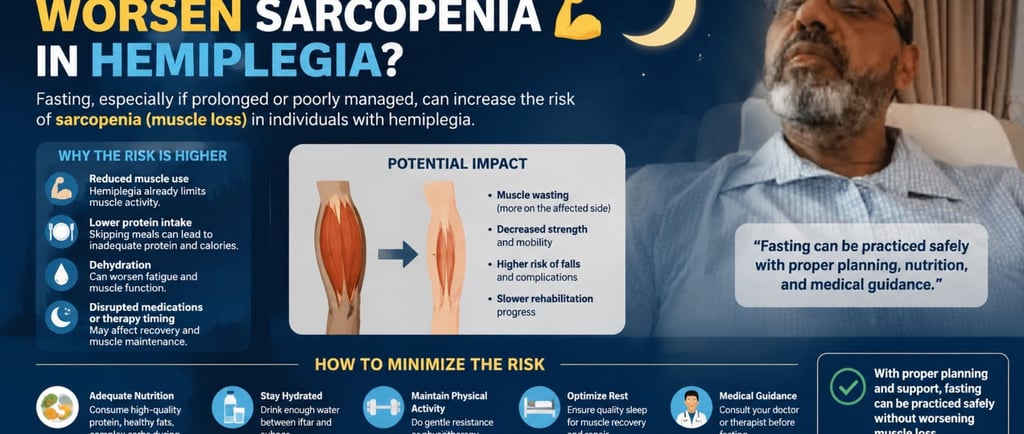
🌙 Can Fasting Worsen Sarcopenia in Hemiplegia? 💪
The short answer: Yes, it can—but it doesn't have to.
People living with hemiplegia (paralysis on one side of the body) are already at increased risk of sarcopenia, the progressive loss of muscle mass and strength. Reduced mobility, lower physical activity, inflammation, and inadequate nutrition can all accelerate muscle wasting.
When fasting is introduced, the effects depend largely on how the fast is practiced and the individual's overall health status.
⚠️ Potential Risks
Insufficient protein intake during eating periods may worsen muscle loss.
Reduced calorie intake can increase the breakdown of muscle tissue for energy.
Physical inactivity during fasting may further accelerate muscle wasting.
Older adults and those with severe disability are especially vulnerable.
✅ Potential Benefits
When properly managed, fasting may:
Improve insulin sensitivity and metabolic health.
Reduce chronic inflammation, which contributes to muscle breakdown.
Support healthy body composition when combined with adequate nutrition.
Encourage healthier eating patterns in some individuals.
💡 How to Fast More Safely with Hemiplegia
✔️ Prioritize high-quality protein at each meal.
✔️ Include resistance or rehabilitation exercises when possible.
✔️ Maintain adequate hydration.
✔️ Avoid prolonged or extreme fasting without medical supervision.
✔️ Monitor weight, muscle strength, and functional ability regularly.
🩺 Bottom Line
For people with hemiplegia, fasting is a delicate balance. While fasting may offer metabolic benefits, inadequate nutrition or prolonged fasting can worsen sarcopenia and impair recovery. Individualized guidance from healthcare professionals is essential to preserve muscle strength while fasting safely.
#Fasting #Hemiplegia #Sarcopenia #MuscleLoss #StrokeRecovery #MuscleHealth #Rehabilitation #PhysicalTherapy #ProteinNutrition #HealthyFasting #HealthyAging #NeurologicalRecovery |
fasting, hemiplegia, sarcopenia, muscle loss, stroke recovery, rehabilitation, muscle preservation, protein intake, physical therapy, intermittent fasting, muscle strength, neurological recovery, healthy aging, clinical nutrition, metabolic health.
====================================================================================================================================================================================



Get in touch
Address
Cairo Al Rehab
Contacts
+20 109 405 2056
hassanalwarraqi@h-k-e-m.com