
Health is a crown on the heads of the healthy that only the sick can see.




🚀 A Deep Dive into Oxygen Therapy & Fasting : Synergy : Breathe. Fast. Heal .
Discover Dr. Hassan Alwarraqi’s HKEM way to accelerate autophagy, clear brain fog, and heal your cells naturally.
FASTINGGENERAL OXYGEN THERAPY
Dr Hassan Al Warraqi
1/16/202610 min read
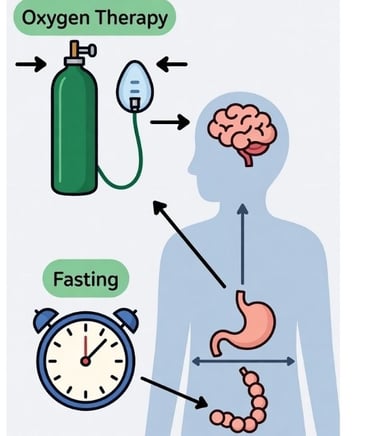
🚀 A Deep Dive into Oxygen Therapy & Fasting : Synergy : Breathe. Fast. Heal .
Discover Dr. Hassan Alwarraqi’s HKEM way to accelerate autophagy, clear brain fog, and heal your cells naturally.
Dr. Hassan Alwarraqi, HKEM Protocol, Oxygen Therapy, Fasting.
Autophagy, David-style fasting, Metabolic health, Kinetic Energy.
Oxygen therapy is a medical treatment that delivers supplemental oxygen to patients who cannot maintain adequate blood oxygen levels independently.
This essential intervention ensures vital organs receive sufficient oxygen for optimal cellular function and healing.
What's Oxygen Therapy?
Oxygen therapy involves breathing air with higher oxygen concentration than the normal 21% found in ambient air.
This increases oxygen delivery to all body tissues that need it.
Different Ways to Get Oxygen
1. Low-Flow Systems
For patients needing modest oxygen supplementation:
Nasal Cannulas: Small tubes inserted into nostrils, delivering 1-6 L/min (24-44% oxygen).
Most common method, comfortable for extended use, allows eating and speaking.
Simple Face Masks: Cover nose and mouth, delivering 5-10 L/min (35-55% oxygen).
Provides higher concentrations than cannulas.
Partial Rebreathing Masks: Include reservoir bag, delivering 6-10 L/min (40-70% oxygen). Bag must stay one-third full during breathing.
Non-Rebreathing Masks: Highest oxygen without mechanical ventilation, delivering 10-15 L/min (90-95% oxygen). Reserved for emergency situations.
2. High-Flow Systems
For patients requiring substantial oxygen support:
Venturi Masks: Deliver precise oxygen concentrations (24-50%) regardless of breathing pattern. Ideal for COPD patients requiring controlled oxygen.
High-Flow Nasal Cannulas (HFNC): Deliver heated, humidified oxygen up to 60 L/min.
Provides positive pressure, reduces breathing effort, improves comfort.
Non-Invasive Ventilation (NIV): BiPAP/CPAP systems delivering oxygen under positive pressure through tight-fitting mask.
Supports both oxygenation and ventilation.
3. Specialized Therapies
Hyperbaric Oxygen Therapy: Breathing 100% oxygen in pressurized chamber (2-3 atmospheres).
Sessions last 90-120 minutes.
Used for decompression sickness, carbon monoxide poisoning, non-healing wounds, radiation injury.
Liquid Oxygen Systems: Portable tanks storing oxygen as supercooled liquid. Compact, refillable for active patients.
Oxygen Concentrators: Extract oxygen from room air.
Portable or stationary units for home use.
Who Needs Oxygen Therapy?
Breathing Problems:
- COPD - proven to increase survival with long-term therapy
- Asthma - during severe exacerbations
- Pneumonia - supports healing during infection
- ARDS - life-threatening respiratory failure
Heart Problems:
- Heart failure - reduces cardiac workload
- Heart attack - supports ischemic tissue (when hypoxemia present)
- Pulmonary hypertension - reduces pulmonary vascular resistance
Other Issues
- Carbon monoxide poisoning - accelerates elimination
- Severe anemia - compensates for reduced oxygen-carrying capacity
- Post-surgical recovery - prevents postoperative hypoxemia
- Chronic wounds - essential for healing processes
Benefits of Oxygen Therapy
Immediate:
- Increases oxygen saturation rapidly
- Relieves breathlessness and air hunger
- Improves tissue oxygenation
- Supports vital organ function
Long-Term:
- Enhances quality of life significantly
- Reduces hospitalization frequency
- Increases exercise capacity
- Improves sleep quality
What to Watch Out For
Oxygen Toxicity : Prolonged high-concentration exposure damages lungs. Risk increases with concentration and duration.
Common Side Effects:
- Nasal dryness and irritation
- Skin breakdown at contact points
- Fire hazard - oxygen accelerates combustion
- Pneumothorax (lung collapse) with positive pressure
Staying Safe
Monitoring
- Pulse oximetry (target 88-92% for COPD, 94-98% for others)
- Arterial blood gases when indicated
- Respiratory rate and breathing pattern
- Overall clinical assessment
Safety Measures
- Absolute no smoking policy around oxygen
- Keep away from open flames and heat sources
- Regular equipment inspection and maintenance
- Emergency preparedness planning
Oxygen at Home
Equipment Options
- Portable oxygen concentrators (4-10 lbs, battery-powered)
- Stationary concentrators (continuous supply, low maintenance)
- Compressed gas cylinders (backup or primary)
- Liquid oxygen systems (high-capacity portable option)
Essential Training
- Equipment operation and troubleshooting
- Safety protocols and fire prevention
- Maintenance procedures
- Emergency response plans
Travel Considerations
- Airlines require advance notice and medical documentation
- FAA prohibits personal oxygen cylinders on aircraft
- Approved portable concentrators available for in-flight use
- Plan for oxygen access at destinations
Hyperbaric Oxygen Therapy Details
Approved Uses:
- Decompression sickness (diving injuries)
- Carbon monoxide poisoning (severe cases)
- Diabetic foot ulcers and chronic wounds
- Necrotizing soft tissue infections
- Radiation tissue damage
How It Works
- Pressurized chamber increases oxygen dissolution in plasma
- Reaches poorly perfused tissues
- Stimulates angiogenesis and healing
- Enhances immune function
Future Developments
Technology Advances:
- More efficient, quieter concentrators
- Longer battery life for portable systems
- Wireless monitoring and remote patient management
- Improved user interfaces
Research Focus
- Optimizing delivery methods
- Reducing complications
- Expanding therapeutic applications
- Improving patient adherence
Oxygen Therapy and Fasting: What's the Story?
Understanding how fasting and oxygen therapy interact is crucial for safe, effective use.
1. How Fasting Affects Your Body
When you fast, your body switches from using glucose to using fat for energy, creating important metabolic changes:
Metabolic Switch
- Shifts from carbohydrate to fat oxidation
- Produces ketones as alternative fuel
- Depletes glycogen stores within 12-24 hours
Cellular Benefits
- Enhanced Energy Efficiency: Mitochondria become more efficient at producing ATP with less oxygen
- Reduced Oxidative Stress: Despite increased fat metabolism, actually decreases harmful reactive oxygen species (ROS)
- Autophagy Activation: Cells clean out damaged components, improving overall function
- Stress Resistance: Activates cellular repair and protection pathways
Result
Cells become better at using oxygen efficiently.
2. Oxygen Therapy: The Details
Supplemental oxygen therapy increases oxygen availability beyond normal 21% air concentration.
Primary Uses:
- Hypoxemia from lung or heart disease
- Chronic wound healing
- Carbon monoxide poisoning
- Neurological or inflammatory conditions
Important Warning: Excessive oxygen causes oxidative damage.
Precise dosing essential.
3. Potential Benefits of Combining Them
When used carefully in appropriate situations, combination may offer advantages:
A. Enhanced Wound Healing
- Fasting reduces inflammation and activates cellular cleanup
- Oxygen supports collagen synthesis and new blood vessel growth
- Timing matters: fasting first, then oxygen therapy
B. Neuroprotection
- Fasting increases brain-protective factors (BDNF)
- Oxygen improves cerebral blood flow and oxygenation
- May support neurological recovery
C. Metabolic Improvement
- Fasting reduces insulin resistance and inflammation
- Oxygen may support cellular metabolism in compromised tissues
4. Critical Safety Warnings ⚠️
NEVER Combine in These Situations:
Hyperbaric Oxygen + Extended Fasting:
- Creates excessive oxidative stress
- Increases seizure risk dramatically
- Depletes electrolytes dangerously
- Recommendation: ❌ Maintain normal nutrition during HBOT
Fasting During Acute Hypoxemia
- If you have low oxygen from infection, lung disease, or anemia
- Body needs fuel to fight illness and support breathing
- Fasting worsens recovery
- Recommendation: ❌ Do not fast during acute oxygen deficiency
Fasting When Critically Ill
- Body in hypermetabolic state requiring substantial energy
- Immune function needs nutritional support
- Rapid muscle breakdown without adequate nutrition
- Recommendation: ❌ Critical illness requires adequate nutrition
5. Getting the Timing Right
Sequential Approach (When Both Are Appropriate):
Phase 1 - Fasting: Short-term (12-72 hours) to reduce inflammation and activate cellular cleanup
Phase 2 - Oxygen Therapy: Resume nutrition and provide oxygen to support active repair
Rationale: Fasting prepares the cellular environment; oxygen provides resources for rebuilding.
6. Key Principles
- Fasting optimizes cellular oxygen efficiency in healthy individuals
- Oxygen therapy addresses oxygen delivery problems
- Combining requires medical supervision and careful timing
- Never fast when oxygen is needed for survival or acute illness
- Context determines safety - stable health vs. acute illness makes all the difference
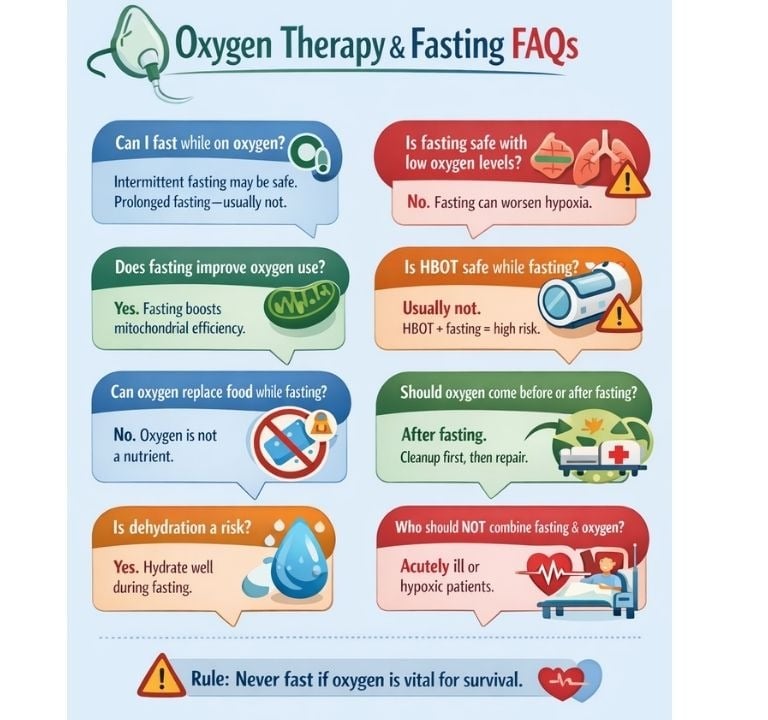
Frequently Asked Questions Oxygen Therapy & Fasting
1. Is it okay to fast while using supplemental oxygen?
Answer
Depends entirely on your medical condition.
If you have stable chronic disease with low-flow oxygen and medical approval, short-term fasting (12-16 hours) may be acceptable.
If using oxygen for acute illness or respiratory failure, fasting is contraindicated.
Always consult your physician first.
2. Is fasting safe with low oxygen levels?
Answer
No.
Hypoxemia from any cause (lung disease, heart problems, anemia, acute illness) makes fasting dangerous.
Your body needs adequate fuel to support increased metabolic demands, immune function, and breathing effort.
Wait until condition stabilizes and oxygen levels normalize before considering fasting.
3. Does fasting help me use oxygen more efficiently?
Answer
Yes, in healthy individuals.
Fasting improves mitochondrial efficiency, enhances cellular oxygen utilization, and reduces oxidative stress.
However, these benefits apply to stable, healthy people - not during acute illness or severe oxygen deficiency.
4. Can oxygen replace food when fasting?
Answer
Absolutely not.
Oxygen enables cells to extract energy from nutrients, but provides zero calories or nutrients itself.
Your body still needs stored energy (fat, glycogen) to function.
Oxygen is like air for fire - essential but not the fuel.
5. Is hyperbaric oxygen safe during fasting?
Answer
No,
extended fasting during HBOT is not recommended.
The combination increases of Oxygen Therapy & Fasting
- Oxidative stress beyond safe limits
- Seizure risk (already elevated in hyperbaric conditions)
- Electrolyte imbalances
- Metabolic instability
Maintain normal nutrition during HBOT courses.
6. Can fasting with oxygen therapy increase oxidative stress?
Answer
Potentially yes.
While fasting alone typically reduces oxidative stress, adding high-level oxygen therapy introduces substantial ROS production.
With low-flow oxygen and short fasts, this is usually manageable.
With extended fasting and high oxygen exposure (especially HBOT), oxidative injury risk increases significantly.
7. Should I fast before or after oxygen therapy?
Answer
When both are medically appropriate, fasting before oxygen therapy generally makes more physiological sense
- Fasting phase: Reduces inflammation, activates autophagy (12-24 hours)
- Oxygen therapy phase: Resume nutrition and provide oxygen for active repair
This sequence may optimize tissue preparation and healing, though clinical evidence is limited.
8. Can intermittent fasting improve oxygen therapy outcomes?
Answer
Theoretically possible but unproven.
Fasting may enhance metabolic resilience, reduce baseline inflammation, and improve cellular repair capacity - potentially augmenting oxygen therapy benefits.
However, rigorous clinical studies are lacking. Any such approach requires medical supervision.
9. I'm on home oxygen—can I practice intermittent fasting?
Answer
Only with doctor's approval.
Key considerations
- Why you need oxygen (underlying diagnosis)
- Disease stability
- Your nutritional status
- Other medical conditions
May be acceptable for
Stable COPD with consistent oxygen needs, well-controlled sleep apnea
Not suitable for
Progressive lung disease, recent hospitalizations, significant weight loss, multiple comorbidities
10. Does oxygen break a fast?
Answer
Oxygen contains zero calories and doesn't break a fast in the traditional sense.
However, medical contexts requiring oxygen therapy often make fasting inappropriate regardless.
11. Do ketones affect oxygen requirements?
Answer
Ketones (produced during fasting) serve as alternative fuel, particularly for the brain.
They don't change oxygen requirements directly, but ketone metabolism has a slightly different oxygen-to-ATP efficiency than glucose.
Ketones neither produce oxygen nor substitute for it - if tissues are oxygen-deprived, ketones cannot compensate.
12. Who should absolutely never combine fasting with oxygen therapy?
Absolute Contraindications:
- Critically ill patients (ICU-level care)
- Severe anemia (hemoglobin <7-8 g/dL)
- Advanced heart failure with unstable symptoms
- Acute respiratory failure
- Active severe infections or sepsis
- Patients undergoing hyperbaric oxygen therapy
- Pregnant or breastfeeding women
- Anyone undergoing chemotherapy (without oncologist approval)
- People with eating disorders
- Elderly frail individuals with muscle wasting
Medical Supervision Essential:
- Diabetes (especially on insulin)
- Recent significant weight loss
- Multiple chronic conditions
- Recent surgery or trauma
13. Can fasting reduce my oxygen requirements over time?
Answer
Possibly very modestly in healthy individuals through improved metabolic efficiency.
However:
- Effect would be gradual and small
- Doesn't treat underlying disease causing oxygen dependence
- Never reduce prescribed oxygen without medical evaluation
- Changes require objective testing (pulse oximetry, blood gases)
Feeling better doesn't mean you need less oxygen - measurements matter.
14. How important is hydration?
Answer
Absolutely critical.
Dehydration impairs oxygen delivery by
- Increasing blood viscosity (thicker blood)
- Reducing blood volume
- Causing electrolyte imbalances
- Affecting cardiac function
Hydration Guidelines
- Drink adequate water throughout fasting
- Monitor urine color (pale yellow = good)
- Consider electrolytes for fasts >24 hours
- Increase fluids during oxygen therapy
15. What's the safest approach?
Evidence-Based Safety Protocol:
1. Never fast during acute illness or when oxygen is life-supporting
2. For chronic stable conditions
- Get medical clearance first
- Start with very short fasts (12-14 hours)
- Progress gradually only if well-tolerated
- Maintain excellent hydration
- Continue all prescribed therapies including oxygen
3. Monitor closely
- How you feel (energy, breathing, mental clarity)
- Oxygen saturation if you have a pulse oximeter
- Warning signs requiring immediate medical attention
4. Remember
Fasting is a wellness tool for stable individuals, NOT a treatment for low oxygen
5. When in doubt, don't do it without medical guidance
Summary and Key Takeaways
Core Principles
✅ Fasting optimizes cellular oxygen efficiency in healthy, stable individuals through improved mitochondrial function and reduced inflammation
✅ Oxygen therapy addresses oxygen delivery problems when the body cannot maintain adequate levels independently
⚠️ Combining requires careful medical supervision - context determines whether it's beneficial or dangerous
❌ Never fast when oxygen is needed for acute illness or survival - recovery requires adequate nutritional support
⏱️ Timing matters - sequential application (fasting first, oxygen therapy second) may optimize benefits when both are appropriate
Clinical Decision Framework
Step 1: Assess health status
- Stable and healthy → May proceed with caution
- Acute illness or unstable → Fasting contraindicated
Step 2: Evaluate oxygen requirements
- No oxygen or stable low-flow → May consider with supervision
- High-flow, mechanical ventilation, or HBOT → Fasting contraindicated
Step 3
Medical consultation mandatory
- Discuss goals and medical history
- Develop individualized protocol
- Establish monitoring plan
Step 4
Start conservatively
- Brief fasting periods initially
- Close monitoring
- Adjust based on response
Step 5
Ongoing assessment
- Regular medical follow-up
- Willingness to modify or stop
- Long-term sustainability evaluation
Bottom Line
Oxygen therapy and fasting are powerful interventions that affect metabolism through different mechanisms.
In the right context (stable health, medical supervision, appropriate timing), they may complement each other.
In the wrong context (acute illness, critical oxygen needs, unstable conditions), combining them can be dangerous.
The fundamental rule
Respect both the power and limitations of these interventions.
Let evidence, medical guidance, and individual circumstances determine all decisions.
When properly used, they offer benefits.
When misapplied, they cause harm.
Medical Disclaimer
This information is for educational purposes only and does not constitute medical advice.
Individual medical decisions should be made in consultation with qualified healthcare providers who can assess your specific situation.
Never modify prescribed therapies or begin new interventions without professional medical guidance.
Dr. Hassan Alwarraqi's approach to fasting is part of his broader HKEM (Holistic Kinetic Energy Management) medical framework.
His method is primarily inspired by the "David-style" rhythm, emphasizing a specific alternating pattern rather than a simple daily window.
The HKEM Fasting Pattern
Dr. Alwarraqi recommends a 3–4 day weekly rhythm.
Unlike the common 16:8 method (fasting for 16 hours every day), this protocol focuses on full-day fasts on specific days of the week:
The Schedule: Fasting on Saturday, Monday, Wednesday, and Thursday.
The Inspiration: This is often referred to as the "David-style" (reminiscent of the biblical/prophetic "Fast of David," which involves fasting every other day).
The Goal: The primary aim is to trigger autophagy (the body's "self-cleaning" mode) and metabolic renewal by allowing longer periods of physiological rest and "biological magic" through hunger.
Key Principles of the HKEM Framework
Fasting is just one pillar of Dr. Alwarraqi's protocol.
The way he integrates it usually involves:
Metabolic Reset: Using hunger as a tool for cellular regeneration.
Kinetic Energy : Combining nutrition/fasting with movement to optimize how the body manages energy.
Holistic Health: He often applies these protocols to manage or prevent chronic conditions, such as stroke recovery or metabolic syndrome.
Practical Tips for This Method
Hydration: Staying hydrated during the fasting days is essential.
Meal Quality: On "non-fasting" days, the focus remains on high-quality, whole foods to support the kinetic energy needs of the body.
Gradual Adoption: As with any intense fasting schedule, he typically suggests monitoring how the body responds to the 4-day-a-week rhythm before making it a long-term habit.
Note: Because this method involves multiple full-day fasts per week, it is highly recommended to consult with a professional, especially if you have underlying metabolic or heart conditions.
===================================================================================================================================================================================
Primary Keywords: Dr. Hassan Alwarraqi, HKEM Protocol, Oxygen Therapy, Fasting.
Secondary Keywords: Autophagy, David-style fasting, Metabolic health, Kinetic Energy.
🚀 A Deep Dive into Oxygen Therapy & Fasting Synergy Breathe. Fast. Heal
https://www.h-k-e-m.com/-a-deep-dive-into-oxygen-therapy-and-fasting-synergy-breathe-fast-heal-
Discover Dr. Hassan Alwarraqi’s HKEM way to accelerate autophagy, clear brain fog, and heal your cells naturally.
===================================================================================================================================================================================



Get in touch
Address
Cairo Al Rehab
Contacts
+20 109 405 2056
hassanalwarraqi@h-k-e-m.com